






















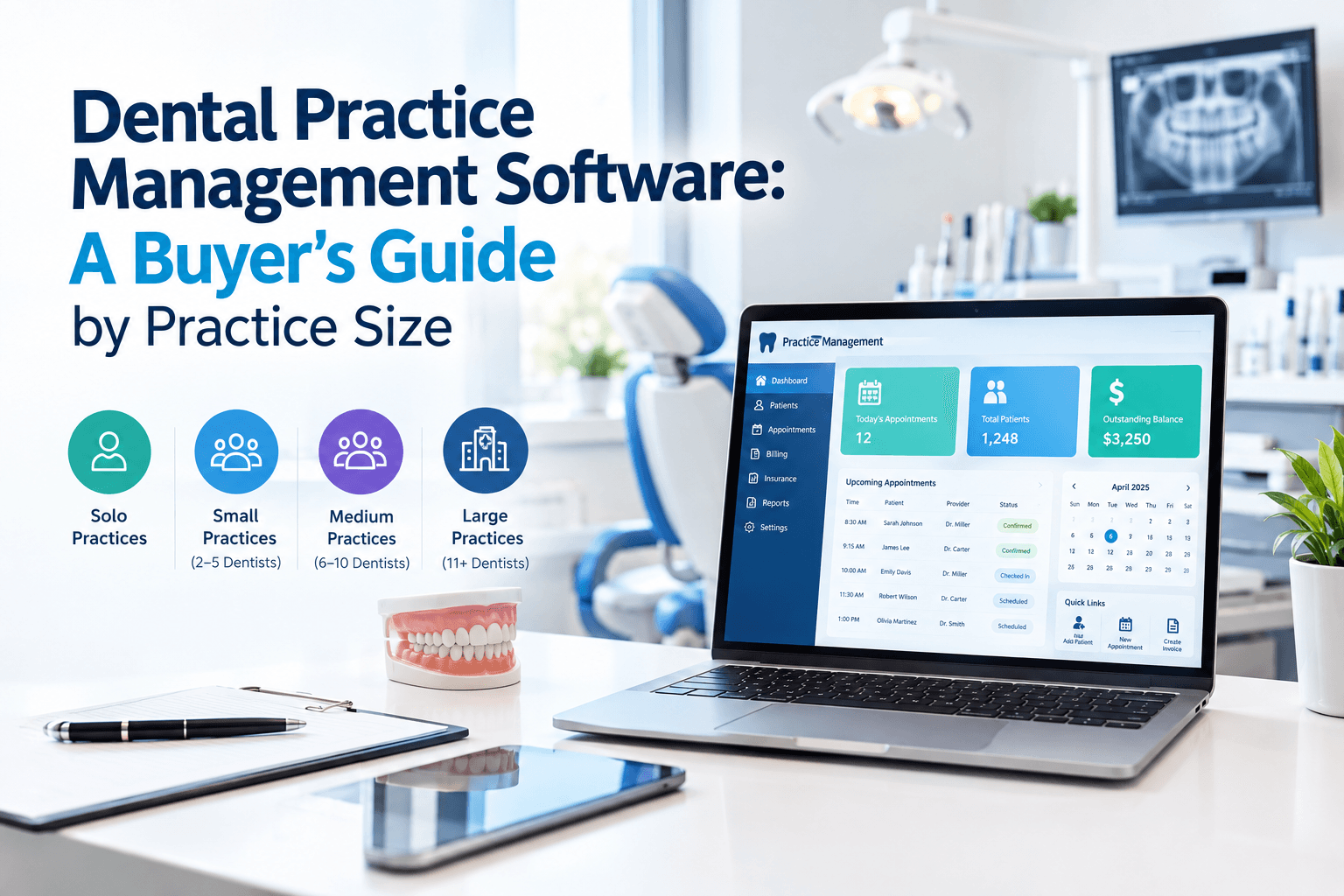
Dental practice management software is the system of record a dental office runs on. It holds patient charts, schedules, treatment plans, imaging, insurance claims, and ledgers in one place so the front desk, hygienists, and dentists all work from the same data. If a workflow touches a patient or a payer, it usually lives inside it.
That definition is the easy part. The hard part is that almost every comparison of dental software you will find ranks platforms as though there were a single best answer, when the right answer changes completely between a single chair practice and a forty location group. The features barely differ. What differs is what happens when you grow.
This guide is organised by practice size, because that is the variable that actually decides the outcome. Woltrio works on the software layer underneath dental and wider healthcare organisations, and the pattern below comes from what breaks at each stage.
What the category actually contains
Every serious dental office software package covers roughly the same ground.
Clinically it holds radiographs, periodontal charting, treatment plans, and clinical notes. Administratively it handles scheduling, insurance eligibility checks, claim submission, payment posting, and patient billing. Around that sit patient communication, reminders, and increasingly online booking.
Because the feature lists converge, reading them side by side tells you very little. Six vendors will all confirm they do scheduling, charting, and claims. The differences that matter sit underneath, in three places: where the data lives, how open the integration surface is, and what the platform does when you add a second location.
One piece of market context worth holding. Analysts describe the degree of innovation in this category as low, attributing it to slow technology adoption among practices, regulatory constraints, and cost sensitivity. That is not a criticism of the vendors so much as a description of the buyer. It also explains why so much of the genuine progress in dental software now arrives as a layer on top rather than as a new core system.
The architecture split that decides everything else
Before practice size, understand the one structural choice.
Server based systems hold the database inside the practice. The classic installed platforms work this way, and for a single location it is genuinely fine. Performance is local, the data is physically yours, and there is no dependency on a connection. The cost arrives later, because each location gets its own database, so five offices means five islands, five backup routines, and no native way to see the group as a whole.
Cloud native systems centralise the data. Staff sign in from any device, multi location reporting works because there is one database rather than several, and the IT overhead moves to the vendor. The trade is dependency and, usually, opaque pricing.
Open platforms sit deliberately between the two, self hosted by default with the option to deploy to cloud infrastructure, and with a far more open integration surface than the category norm.
That third category matters more than its market share suggests, because integration openness is what determines whether you can ever build anything of your own on top. It is worth noting that the major cloud platforms have moved substantially in this direction too, with one vendor publicising several hundred API endpoints and a partner ecosystem in the hundreds as of early 2026. Openness is becoming a competitive axis rather than a niche position.
Solo and small practices, one to two providers
At this size the correct instinct is to spend as little management attention on software as possible.
What matters is total cost of ownership, published pricing so you can plan, and a support model that works when you have no IT staff. Data ownership is worth caring about now even though it will not bite for years, because the cost of leaving a platform is paid by whoever you become later.
What does not matter yet is multi location capability, enterprise reporting, or centralised anything. Buying for the practice you intend to become in a decade is the most common overspend at this size, and the features sit unused while the subscription runs.
The realistic failure mode here is not choosing the wrong platform. It is under using the one you have, because nobody configured the recall system or the reminders properly during a rushed onboarding.
Growing practices, three to ten providers
This is where dental practice software starts to strain, and where the decisions get interesting.
Depth of features and support infrastructure begin to matter, because more staff means more edge cases and more people who need training. The established platforms tend to fit well at this size for exactly that reason.
Two things start to hurt.
Reporting. You begin asking questions that span providers and, if you have a second site, span locations. On a server based system that means running the same report in two places and reconciling by hand. It is tedious rather than catastrophic, and it is the first genuine signal that the architecture is becoming a constraint.
The front desk. Staff time disappears into eligibility checks, claim follow up, form entry, and phone scheduling. This is where most practices at this size have the largest recoverable cost, and it is almost never a practice management software problem. It is a workflow problem sitting next to the software, which is why tooling like intake forms software and patient facing scheduling often returns more than a platform change would.
Multi site groups and DSOs, ten locations and up
At this scale the question changes from which dental practice management systems have the best features to whether the group can operate as one organisation.
The purpose built multi location platforms exist for this, and they solve the centralisation problem properly: one database, standardised configuration across sites, and reporting that treats the group as a unit rather than as a collection.
The complication is that most groups do not arrive here cleanly. They arrive by acquisition, which means inheriting whatever each acquired practice was running. A group of twelve locations frequently runs three different systems, two of them server based, with the third partially migrated. Everything below is downstream of that reality.
Three things reliably become priorities.
One version of the numbers. Not more dashboards. One agreed definition of a completed visit, a production figure, and a recall rate, applied identically everywhere.
Deployment repeatability. Adding location thirteen should cost meaningfully less than location twelve did. If it does not, the group has a scaling problem regardless of which platform it runs.
A decision about the estate. Standardise everyone onto one system, or build a layer that reads from all of them. The second is far more common than vendor content suggests, because it is cheaper, faster, and does not require retraining every front desk simultaneously.
When reporting stops being a module
Somewhere between five and fifteen locations, analytics stops being something the practice management system does and becomes its own problem.
The reason is structural. A practice management platform reports on the data it holds. A group needs to combine that with payer data, imaging systems, patient communication platforms, and often a general ledger that lives somewhere else entirely. No practice management system is going to do that well, because it was never the job.
This is the point at which a dental group starts evaluating the same category a hospital does when it outgrows departmental reporting. A hospital analytics platform and a multi site dental analytics layer solve structurally identical problems: unify data from several source systems, agree definitions once, and serve one view to people who currently reconcile by hand. The clinical vocabulary differs. The architecture does not, which is why healthcare data analytics platform work applies across both.
The sequencing advice is the same in either setting. Get the definitions written down before buying anything, because a platform built on contested metrics reproduces the disagreement faster and at higher cost.
AI in dental software, and why you probably do not need to switch
Through 2026 the platforms have been embedding AI directly. One multi location vendor launched an embedded agent product in February 2026 aimed initially at appointment confirmation and scheduling, and the established cloud platforms have added voice driven clinical notes, eligibility automation, and image quality checking.
The important practical point, and the one vendors are least motivated to tell you, is that you generally do not need to change your practice management system to add modern AI capability. The credible tools in this space integrate with the major platforms rather than requiring you to move to them. Anyone recommending a full platform migration in order to access AI features is selling a migration.
Where the return is currently clearest is the unglamorous back office: eligibility verification, claim follow up, payment posting, and reconciliation. High volume, rule bound, and measurable. Broader context on where healthcare software investment is concentrating sits in the top areas in healthcare SaaS worth investing in guide.
What switching actually costs
Because migration is the option every buyer considers and few price properly.
A full platform migration typically runs sixty to a hundred and twenty days including data conversion, training, and transition. That is the visible part. Analysis of a five doctor practice migration in early 2026 found the indirect costs substantially exceeded the direct ones, driven by a thirty to forty percent productivity drop in the first month, a no show rate rising by roughly half during the transition, and somewhere between eight and fifteen percent of data records failing to map correctly on first pass.
That last figure deserves attention. Records that fail to map are not lost, but they need manual reconciliation, and the work lands on staff who are simultaneously learning a new system while seeing a full schedule.
None of which means never migrate. It means migrate when the current system genuinely blocks growth, which is a higher bar than being annoyed by it, and it means budgeting for the month you will not be at full production.
When you need an EHR software development company
Most dental practices never need custom development, and any partner who tells you otherwise is selling.
The cases where it genuinely applies are narrow and recognisable. A multi site group needing unified reporting across systems no single vendor covers. A speciality whose workflow no general platform models properly. A group where manual workarounds have quietly become the real process. Or a dental technology company where the software is the product being sold rather than the tool being used.
In those cases what you are hiring is integration and data capability rather than a replacement platform. The useful engagement is usually smaller than the brief that arrives, because the honest answer is often to build a layer rather than a system. Patient facing work follows the same logic, where patient portal software development sits alongside the practice management platform rather than replacing any part of it.
Where Woltrio fits
Woltrio builds the software layer around clinical systems rather than selling a practice management platform, which is the reason this guide can be direct about when not to change anything.
For dental groups that usually means one of three engagements: a reporting and extraction layer across mixed systems, integration work connecting the platform to the tools around it, or custom build where the workflow genuinely has no product equivalent. The full service range sits under services, and the dental specific work under dental practice management software.
Most engagements start with an assessment rather than a proposal, because at every practice size above the first, the expensive mistake is solving an architecture problem with a feature purchase, or a workflow problem with a migration. Getting that distinction right is most of the value, and it is the part that has to happen before anyone writes code.
The team building this work is described under careers, and the wider site sits at woltrio.com.