






















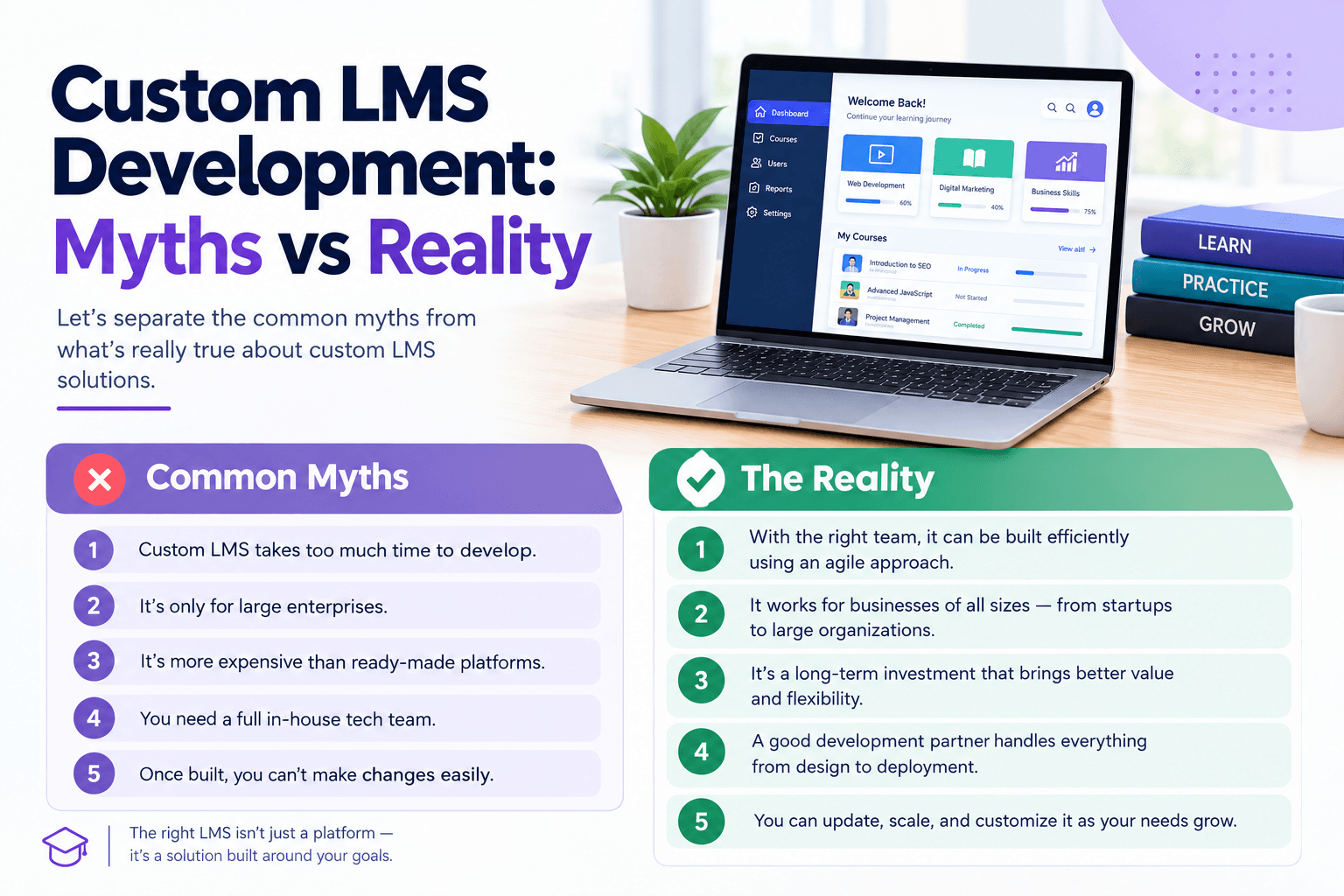
Custom LMS development gets discussed in a lot of confident, secondhand claims, "custom is always better," "AI will handle adoption," "compliance is basically automatic once it's built." Some of these hold up. Most don't survive contact with an actual project.
Myth 1: Custom LMS Development Is Always Better Than Buying an Existing Platform
Reality: custom development is the right call when workflow, integration, or compliance needs are genuinely specific to an organization, healthcare certification cycles, multi-location role structures, audit formats an off the shelf system can't produce. If training needs are fairly standard, general onboarding, general compliance modules, an existing platform is often the faster, cheaper, and entirely reasonable choice. "Custom" is a fit decision, not a universal upgrade.
Myth 2: If the LMS Has Good Reporting Features, Compliance Is Basically Handled
Reality: reporting features are only as good as the data underneath them. If certification tracking, completion records, and role changes aren't captured cleanly at the data layer, a polished reporting dashboard just produces a polished, inaccurate report. Compliance depends on the whole chain, clean data sync with HR, accurate assignment logic, and reporting that reflects reality, not just the dashboard at the end of it.
Myth 3: A Custom LMS Doesn't Need Single Sign-On If Staff Are Willing to Use a Separate Login
Reality: staff willingness to tolerate a separate login isn't the same as it being a good decision. Separate logins create account drift over time as HR records and LMS records fall out of sync, and they add daily friction that quietly suppresses completion rates even when nobody complains loudly about it. Woltrio treats identity integration as a foundational architecture decision in every custom LMS solutions project, not an optional convenience.
Myth 4: AI Will Fix Low Completion Rates
Reality: AI-driven reminders and automated nudges genuinely help, and Woltrio builds this kind of targeted automation into AI and automation services regularly. But automation compensates for friction, it doesn't eliminate it. If the underlying interface is confusing or the assignment logic doesn't match how staff actually work, smarter reminders just mean people ignore the system more efficiently. Adoption problems rooted in design need design fixes, not just better reminder timing.
Myth 5: Building Custom Means Building Everything From Scratch
Reality: the parts of an LMS most organizations actually need custom, workflow logic, HR and identity integration, compliance reporting formatted to their specific needs, are a fraction of the total system. Course delivery mechanics, video playback, quiz logic, don't usually benefit from being reinvented. A learning management system development company that insists on custom-building everything regardless of need is usually optimizing project size, not the client's actual outcome.
Myth 6: A Pilot Phase Just Delays the Real Rollout
Reality: a pilot with one department surfaces integration and design problems at a manageable scale, before they show up organization-wide. Skipping straight to a full rollout doesn't avoid these problems, it just means they surface everywhere at once, at the worst possible scale to fix them. Woltrio's MVP development approach exists specifically to catch this kind of risk early rather than delaying unnecessarily.
Myth 7: The Vendor's Demo Is a Reliable Preview of How the System Will Actually Perform
Reality: demos are built to show the easy path. They rarely simulate a messy real scenario, a role change mid-certification-cycle, an HR sync conflict, an audit request for a specific report format. Ask vendors directly how the system handles these scenarios rather than relying on what a polished demo shows.
What Separates Projects That Actually Work
Looking past the myths, the projects that hold up after launch tend to share a few real patterns: a discovery phase that maps actual workflows before any development starts, identity and HR integration treated as foundational rather than a later configuration step, design informed by the staff actually completing training, not just administrators, and a pilot phase before a full organization-wide rollout. None of this depends on how much of the system was custom-built. It depends on whether the right parts were.
Quick Answers
Custom LMS development is the right fit when workflow, integration, or compliance needs are genuinely organization-specific, not a universal improvement over existing platforms.
Good reporting features don't guarantee compliance if the underlying data and workflow layers aren't built cleanly.
Single sign-on should be treated as foundational, not optional, since separate logins create both friction and long-term data drift.
AI automation helps with adoption but doesn't fix underlying design or workflow problems on its own.
A pilot phase catches problems at a manageable scale before a full rollout, rather than simply delaying launch.
Common Questions
How do we know if we actually need custom LMS development?
If training workflows, integrations, or compliance reporting are genuinely specific to your organization, custom development usually pays off. If needs are fairly standard, an existing platform may be sufficient.
Can an existing LMS be improved with targeted fixes instead of a full custom rebuild?
Often, yes. Many issues trace back to one or two weak areas, like integration or reporting, rather than requiring a complete replacement.
What should we ask a vendor to see past a polished demo?
Ask how the system handles specific messy scenarios: a mid-cycle role change, an HR sync conflict, or a specific compliance report format your organization actually needs.
Next Step
A discovery conversation through the Woltrio homepage is a practical way to separate which of these myths apply to your specific situation before committing to an approach.